Blackfriars
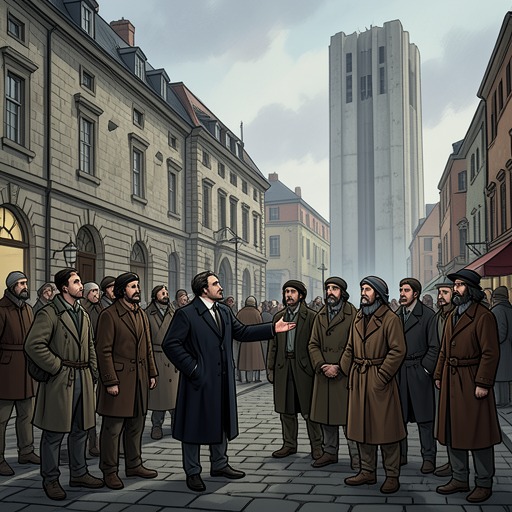
Wolf HallBlackfriars is the London setting of the legatine court convened to hear Henry VIII’s Great Matter: whether his marriage to Katherine of Aragon was valid. The crowded hearing brings the king and queen before the two cardinals, but its public spectacle cannot settle the deeper contest between royal power, ecclesiastical jurisdiction, and personal conscience.
The hearing and its participants
The court is convened after the king’s effort to establish that Katherine had consummated her earlier marriage to Prince Arthur. Witnesses are sought from among those who attended the couple after their wedding, including at Baynard’s Castle and Windsor. Their testimony concerns events twenty-eight years earlier, making the reliability of their memories an immediate problem. The case turns not simply on what they remember, but on who may judge the marriage and what evidence should count.
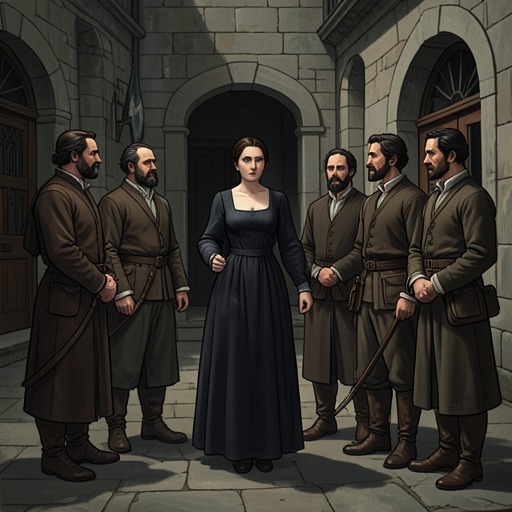
Katherine refuses to let the proceedings reduce her to an absent subject of debate. Although observers had expected her to send a proxy, she appears in person before the assembled bishops and the two cardinals. Henry answers when called, his voice carrying through the hall. Thomas Cromwell, watching from a distance with Rafe Sadler, thinks that a restrained gesture of deference might have served the king better than conspicuous confidence. In his view, humility can be a performance, but a persuasive one.
Katherine’s challenge to the court
Katherine argues that the matter remains under consideration in Rome and that the judges are biased against her. She also challenges the impartiality of Cardinal Campeggio, whose close association with Thomas Wolsey, she believes, makes him untrustworthy. Her resistance is sharpened by the fact that she has been urged to accept the marriage’s invalidity and retire to a convent; her answer is that she would do so if the king became a monk.
The court’s procedure gives way, when Katherine is absent, to testimony about her first marriage and her claim that she had not been Arthur’s wife in the full sense. She has permitted her confessor to speak publicly about what she told him, breaking the seal of confession in support of her case. The narrative also points to the competing documentary evidence: Spanish and English versions of the marriage dispensations differ, and the question might have been addressed through their wording rather than through a public contest over sexual history. Blackfriars thus becomes the stage on which a private marriage is made into a legal and political spectacle.
A public spectacle, a private judgment
The hearing is packed, and Katherine’s appearance moves some of those present to tears. As she leaves, Cromwell and Rafe discuss whether the king could meet her eyes. Rafe admits that he believes Katherine; Cromwell answers that no one should be believed. Their exchange makes the court’s uncertainty personal: the public record may be shaped by the king’s objective, while the people witnessing it continue to form judgments the proceedings cannot control.
Stephen Gardiner confronts Cromwell after the hearing, warning that if the court cannot give the king what he wants, Wolsey’s former servant will be vulnerable too. Cromwell treats the threat as a revelation of the factional stakes surrounding the trial. Blackfriars is therefore not an isolated legal venue: its proceedings are bound up with the rivalry among the king’s advisers and the consequences of Wolsey’s fall.
The location’s wider political meaning
The novel returns to Blackfriars as a place where political authority is staged and tested. In the struggle over seats in the new Parliament, Rafe Sadler reports that Thomas Howard, Duke of Norfolk, is willing to receive Cromwell into his service, while suspecting that Cromwell knows where Wolsey’s supposed treasure lies. Cromwell’s movements between Wolsey’s circle and Norfolk’s political world show how the court’s earlier crisis continues to shape patronage and allegiance.
Blackfriars also figures in the wider legal transformation of the realm. Cromwell later brings a bill concerning the suspension of annates to the Commons and uses a division of the House to make members’ positions visible to the king. The association is not that every political action occurs at the hearing’s site, but that the novel repeatedly links Blackfriars with contests over who holds authority: the pope, the church, Parliament, or the crown. Its most memorable scene leaves that contest unresolved in the faces of the king and queen, and in the judgments of those watching.